
Why AI Needs Strong Managers
The Davos Reality Check
At the World Economic Forum's annual meeting in Davos, Switzerland, PricewaterhouseCoopers presented findings from a global survey of more than 4,500 CEOs. Nearly half reported they have seen no significant financial benefit from AI so far, despite years of investment, experimentation, and executive attention.
This gap between promise and performance is not primarily a technology problem. It is a leadership one.
What we are witnessing is a collision between increasingly capable autonomous software and a timeless organizational failure: the inability to delegate work effectively. AI is being introduced into enterprises as a new class of “digital worker,” yet most organizations lack the management frameworks required to ensure trust, accuracy, and accountability at scale.
The result is a familiar pattern. Leaders oscillate between two extremes: total abdication, where AI outputs are trusted too readily, and anxious micromanagement, where every result is manually corrected, negating the very efficiency AI was meant to deliver. Neither approach produces durable value.
To move forward, particularly in regulated industries like banking, leaders must look beyond models, prompts, and architectures and return to first principles: how work is delegated, governed, and overseen.
Timeless Common Sense, Reapplied
Strong business leaders have always distinguished themselves by their ability to delegate effectively. Delegation is not about offloading work. It is about applying domain judgment to assess a task's complexity, business impact, and risk, then deliberately deciding what can be delegated, to whom, and under what level of oversight.
Done well, delegation improves outcomes while simultaneously building organizational capacity. Done poorly, it creates rework, risk, and erosion of trust.
Despite its importance, many leaders either abdicate responsibility prematurely or fail to delegate at all. In both cases, the result is suboptimal performance. AI magnifies these failures. It does not forgive vague instructions, unclear accountability, or misplaced trust.
Mastering delegation has always been a critical leadership skill. Applying it rigorously to AI is now a prerequisite for realizing value.
The Four Levels of Delegation
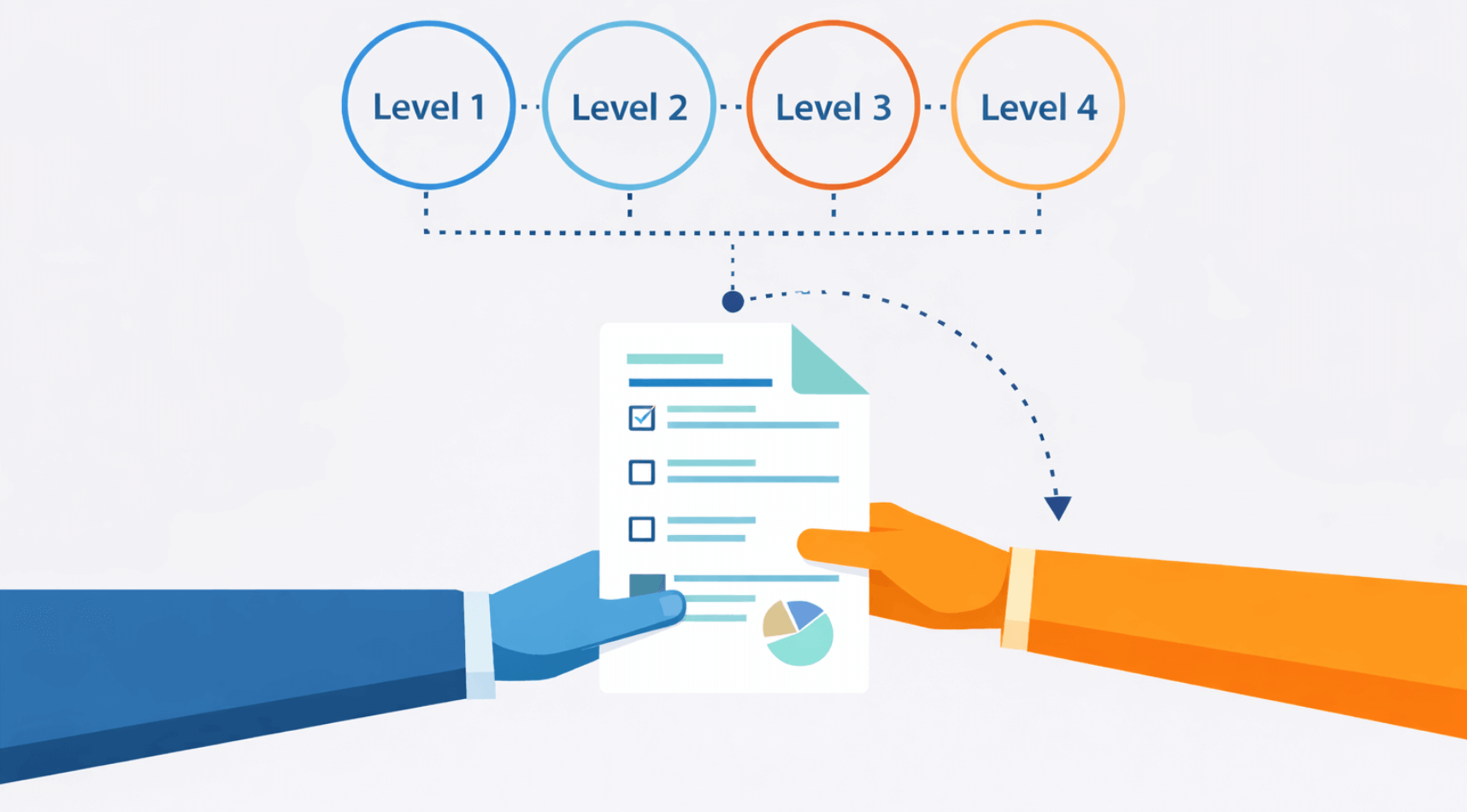
In people management, effective leaders intuitively operate through four levels of delegation. These levels are not static or based on hierarchical status. Instead, they are situational, task-specific, and reversible. A single individual may operate at multiple delegation levels simultaneously across an array of different responsibilities.
As delegation increases, leverage and scale improve, but control, visibility, and tactical accountability decrease. Most high-performing organizations operate primarily at Levels 2 and 3, reserving Level 4 for narrow, well-understood domains, and Level 1 for junior or newly onboarded talent.
These same principles apply directly to AI.
Level 1: Assisted Execution
People Delegation: “Give me exactly what I asked for.”
At Level 1, AI functions strictly as an assistant. It provides drafts, suggestions, summaries, or calculations, but makes no decisions. Humans retain full control and accountability.
In banking and marketing, this includes tasks such as drafting customer communications, summarizing data, generating creative variations for review, or extracting information from documents. The AI accelerates work, but every output is evaluated, edited, and approved by a human.
At this level, AI is intentionally constrained. Scope is narrow, supervision is close, and every output is reviewed before use. While it may appear modest, Level 1 is where organizations build the skills and proficiency required to work effectively with AI before increasing its autonomy.
Level 2: Verified Recommendation
People Delegation: “Create options and I'll choose.”
At Level 2, AI begins to shoulder more of the analytical burden. It generates recommendations or proposed actions, but nothing proceeds without explicit human approval.
This is the dominant mode for compliance-heavy environments. In banking, AI may score credit risk, flag regulatory issues, draft customer support responses, or propose segmentation strategies, while human experts review and approve each decision.
Here, value emerges from efficiency and consistency, but only if leaders possess the domain expertise to validate AI outputs. Without that expertise, organizations either rubber-stamp recommendations or reject them wholesale, undermining the distinct value AI is designed to deliver.
Level 3: Delegated Authority Within Guardrails
People Delegation: “Do it how you see fit, within explicit constraints.”
Level 3 marks a meaningful shift. AI is authorized to act independently within predefined boundaries. Humans define policies, thresholds, and escalation paths, monitor performance, and intervene only when exceptions occur.
This level enables real scale. In banking, it includes fraud detection systems that automatically flag or block transactions, customer support bots handling routine inquiries, or marketing platforms optimizing campaigns within approved parameters.
The success of Level 3 depends less on model sophistication than on management discipline. Leaders must be explicit about data foundations, clearly defined compliance guardrails, success criteria, and escalation paths. Ambiguity at this level leads to either excessive overrides or uncontrolled risk.
Level 4: Conditional Autonomy
People Delegation: “I trust you to run it end-to-end.”
Full autonomy is rare and should remain so. At Level 4, AI owns an entire process with minimal human involvement. Humans set high-level objectives, if any, and review outcomes retrospectively.
In banking, this is typically limited to tightly bounded domains such as high-frequency trading, infrastructure optimization, or specific cybersecurity controls, where outcomes are observable and containment is manageable.
Granting Level 4 authority in customer-facing or regulatory-sensitive processes without earned trust is not leadership. It is abdication disguised as innovation.
Why Leaders Misplace AI on the Delegation Curve
Most organizations fail with AI not because the technology is immature, but because leaders misjudge where AI belongs on the delegation spectrum relative to clearly defined tasks and operating conditions.
Like people, AI is jagged. It excels at certain tasks and fails at others. Strong managers assign work based on skill fit, risk, and task demands, recognizing that the same contributor may operate at different levels of delegation across responsibilities. With AI, many leaders abandon this judgment, treating systems as either magical or dangerous.
The result is widespread confusion. Leaders lack clarity on what to delegate, which AI capabilities are best suited to each task, and where autonomy should begin and end. This lack of confidence ultimately limits innovation.
The organizations seeing returns from AI are not those racing toward autonomy, but those methodically progressing through Levels 1 to 3, tightening guardrails, and expanding scope only when trust is earned.
What Strong AI Management Actually Looks Like
Effective AI leadership is not about enthusiasm or vision. It is about discipline.
Strong managers define what “good” looks like. They set clear expectations, specify acceptable variance, and insist on accountability. They design escalation paths and audit mechanisms. Most importantly, they revisit delegation decisions as conditions change.
AI does not replace leadership judgment. It demands more of it.
| Delegation Level | Human Role | AI Role | Appropriate Use |
|---|---|---|---|
| Level 1 — Assisted | Full control, final decision | Drafts, suggestions, analysis | High-risk, high-scrutiny tasks |
| Level 2 — Verified | Reviews and approves | Recommends actions | Compliance-heavy processes |
| Level 3 — Delegated | Sets guardrails, monitors | Acts within constraints | Scalable routine operations |
| Level 4 — Autonomous | Sets objectives only | Owns entire process | Narrow, low-risk domains |
Closing: The Leadership Gap Exposed
The Davos findings should not surprise us. AI exposes what has always mattered in organizations: clarity of delegation, strength of judgment, and accountability for outcomes.
The leaders who succeed with AI will not be those who adopt the most advanced models first. They will be those who manage AI with the same rigor they apply to people.
AI does not need hype-driven risk or fear-based restraint. It needs strong managers.
About PilotLaunch.AI
PilotLaunch.AI is a strategy-led advisory that helps consumer banks modernize customer experience and AI adoption through structured, controlled experimentation, supported by proprietary methodologies and purpose-built technology. We work with bank teams to define high-value use cases, establish clear guardrails and success metrics, and stand up disciplined pilot environments that turn ambition into evidence and evidence into production-ready outcomes.